 ConsultingByte
Point of View
The Real Constraint on Agentic AI Isn't Intelligence — It's Coordination
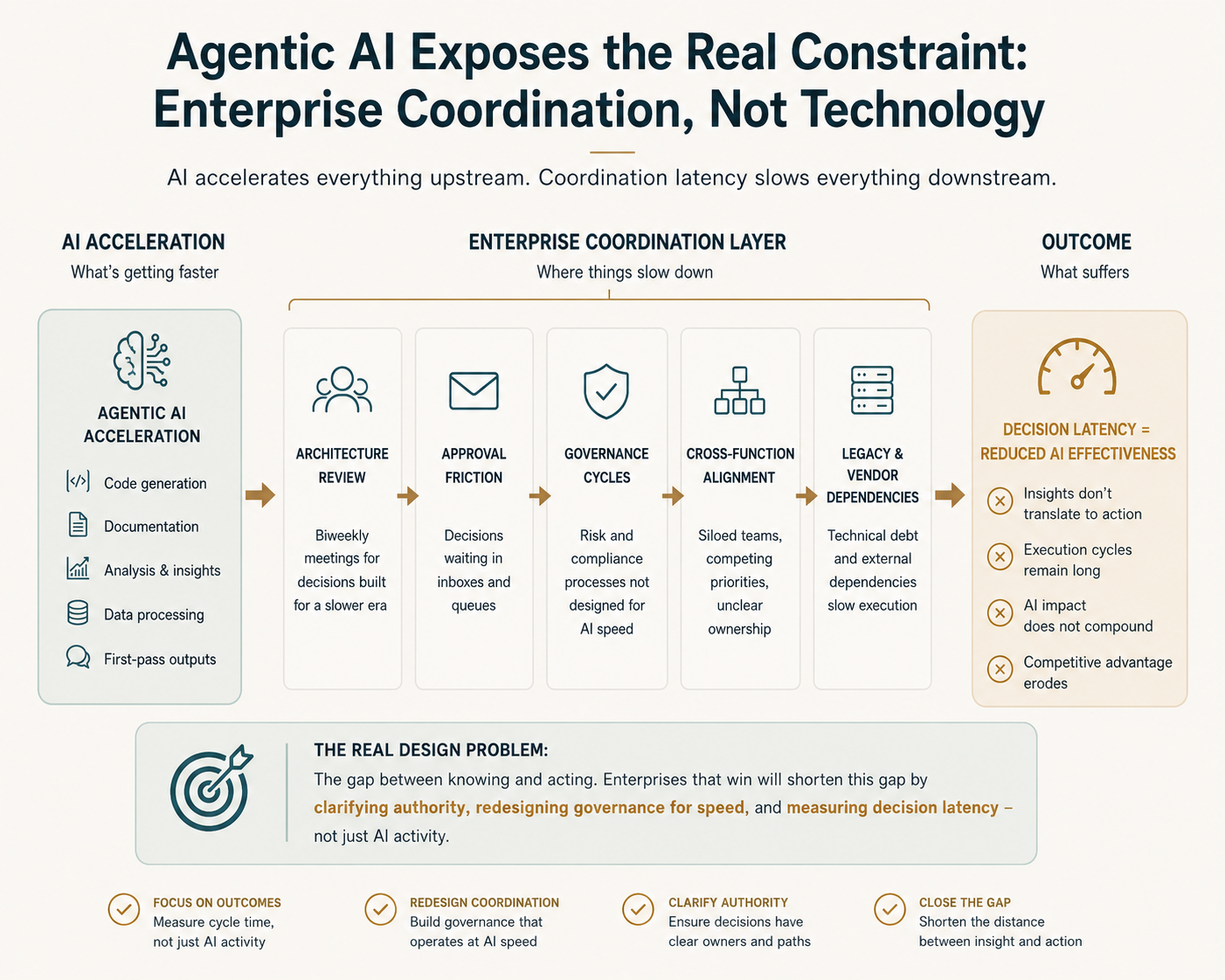
A few weeks ago, during a dinner with a longtime colleague, I overheard a conversation at the next table about agentic AI. It was the kind of animated certainty that has become increasingly common in enterprise circles over the last year: the belief that AI agents are about to fundamentally compress the cost, speed, and scale of organizational execution. In many ways, that optimism is justified. The pace of progress in agentic systems has altered more than just technology roadmaps. It has changed enterprise expectations themselves. The traditional mandate of "do more with less" is rapidly evolving into something far more ambitious: do dramatically more, almost immediately, with the systems, teams, and structures already in place. Thanks to hyperscaler investment and the acceleration of model capabilities over the last eighteen months, that expectation no longer sounds unrealistic. The capability is real.
And yet, anyone who has spent a career inside large enterprises, not AI labs or startups, but banks, insurers, retailers, industrial companies, knows that capability has never been the scarce resource. Enterprises have had access to more computing power, more talent, and more capital than most disruptors for decades. What they have not had, consistently, is the ability to decide and move quickly, the "agility." That gap is not closing as fast as the technology is advancing, and agentic AI is about to make it more visible than it has ever been.
This is the uncomfortable thesis worth sitting with: agentic AI will expose enterprise coordination failure long before it meaningfully improves enterprise productivity. Not because the technology is deficient, but because the organizations deploying it were never built for the speed it enables.
Why Enterprise AI Adoption Is a Different Problem Than Lab or Startup AI Adoption
It's worth being precise about why this matters, because the comparison between AI labs and large enterprises gets thrown around loosely. An AI lab or a well-funded startup optimizes for one thing: velocity of iteration. A small number of people own a decision end to end. There is no annual OKR cycle standing between an idea and a shipped change. If something doesn't work, it gets killed in a day, not a quarter.
Large enterprises are not built this way, and for mostly good reasons. They are built to protect predictability of earnings, of risk exposure, of regulatory posture, of customer experience at scale. A bank does not want its core ledger system iterating at startup speed. Predictability is not a design flaw; it's the product of decades of hard-learnt lessons about what happens when large, interconnected systems move too fast without control.
The trouble is that this same design, layered governance, staged approvals, annual planning cycles, was calibrated for a world where the cost of being slow was tolerable. A twelve-month roadmap used to be a reasonable cadence. Quarterly planning was an acceptable rhythm. Governance review cycles that took weeks were a nuisance, not an existential disadvantage, unless a genuine regulatory issue was on the table.
Agentic AI breaks that calibration. It compresses execution timelines, time-to-market, iteration time, feedback loops, at a rate enterprise coordination structures were never designed to match. The technology is not the constraint anymore. The organization is.
The Architecture of Enterprise Coordination
To understand why this gap exists, it helps to look at how a typical large enterprise is actually structured, not on the org chart, but in the way work genuinely moves through it.
Business sets priorities. Product translates them into requirements. Architecture governs how those requirements fit into the broader technology estate. Engineering builds. QA validates. Vendors and third parties sit somewhere in the middle of all of it, often owning pieces of the stack that no internal team fully controls. Each of these functions optimizes locally, for its own metrics, its own risk exposure, its own definition of "done." Each one is, in isolation, often executing well and working its own agenda.
The failure mode is not incompetence inside any one silo. It's the handoffs between them. A request for architectural sign-off queues behind a review board that meets biweekly. A dependency on another team's roadmap doesn't resolve until their next planning cycle. Data needed for a decision usually sits in a system three teams away, gated by an access request process nobody remembers designing. None of this shows up in a capacity plan. All of it shows up in the calendar.
This is not a uniquely anecdotal problem. McKinsey's research into operating model design, drawn from a 2024 survey of more than 750 senior executives at global companies, points to the same root cause: as organizations grow along product, functional, and regional lines simultaneously, accountability becomes harder to trace, and decision rights blur across the resulting matrix. The structure itself, not any single team's competence, is what slows the system down.
This is why AI labs look disruptive and large enterprises look slow, even when the enterprise has more resources at its disposal. It is rarely a talent gap or a tooling gap. It is a structural one: the number of boundaries a decision must cross before it becomes action.
How Decision Latency Quietly Limits AI Effectiveness
I've seen this pattern repeatedly in large enterprise environments, particularly in complex investment management and compliance platforms where post-trade data moved across multiple business units with significant operational dependencies. In one such environment, critical portfolio and compliance data still relied on batch-oriented ETL flows, which meant key decisions were often being made on delayed or partially synchronized information. The technical limitations were understood. The harder problem was organizational inertia: modernization competed against vendor dependencies, legacy integration risk, operational stability concerns, and the institutional reluctance to disrupt systems that were still functioning "well enough."
What emerged was a recurring cycle common across many enterprises today: latency became normalized because the organization adapted around it. Teams compensated with spreadsheets, side processes, fragmented reporting models, and manual coordination layers outside the formal system of record. The real breakthrough did not come from simply improving application performance. It came from rethinking the architecture and operational flow itself, moving from sequential, delayed processing toward event-driven, near-real-time decision support.
This is where many enterprise AI conversations still miss the real constraint. Enterprise AI failure is almost never model failure. It is latency in decision propagation across organizational boundaries. Decision latency is the true translation layer between AI capability and enterprise value.
McKinsey's own research on executive time allocation reinforces just how deep this problem runs before AI even enters the picture: senior executives report spending close to 40 percent of their time on decisions, and by their own account, most of that time is poorly used. Only around a third of respondents said their organizations consistently make decisions that are both fast and high quality.
If decision-making itself was already the constraint before agentic systems arrived, compressing the execution layer around that constraint does not remove it. It only makes the constraint more expensive to ignore.
The distinction becomes clearer when separating productivity from throughput, two concepts enterprises frequently treat as interchangeable. Productivity measures how efficiently individuals or teams execute tasks. Throughput measures how efficiently the organization converts ideas into measurable outcomes. Most transformation initiatives heavily optimize productivity within engineering while leaving the broader enterprise flow largely untouched.
A typical enterprise initiative still moves through a familiar sequence: request, requirements, architecture review, dependency management, development, testing, release, and finally business adoption. Engineering execution occupies only one segment of that chain, yet it receives disproportionate attention because it is the most visible and easiest to measure. The largest delays usually emerge elsewhere, either upstream in alignment, prioritization, and architecture governance, or downstream in release coordination, approvals, operational readiness, and business adoption.
This is precisely why agentic AI often creates the illusion of acceleration before producing meaningful enterprise gains. Code generation may become faster. Documentation may become instantaneous. Initial analysis may compress from days into minutes. But when the surrounding coordination system remains unchanged, the bottleneck simply migrates to the next organizational boundary. The enterprise experiences localized speed improvements without materially improving overall throughput.
Most enterprise delay no longer originates in technology execution itself. It originates in the organizational distance between insight, decision, and coordinated action.
Why Agentic AI Exposes Operating Model Weaknesses — It Does Not Resolve Them
This is where much of the current enterprise AI enthusiasm begins to drift toward the wrong conclusion. A rapid proof-of-concept demonstrates how quickly an agent can generate code, summarize requirements, or automate analysis, and the initiative quickly centers itself around productivity metrics: lines of code generated, pull requests opened, tasks completed, or hours saved. These are visible improvements, but they often measure acceleration inside a single function rather than improvement across the enterprise system as a whole.
I was once told, only half-jokingly, that a team's agents were generating commits faster than the CI/CD pipeline could absorb them. The constraint had not disappeared. It had simply moved downstream. This is the pattern many organizations are now beginning to encounter. Agentic AI accelerates localized execution, but the surrounding coordination system, approvals, governance, architecture review, release management, cross-team dependencies, and decision rights, often continues to operate at legacy enterprise speed.
Deloitte's most recent State of AI in the Enterprise research, drawn from a global survey of more than 3,000 business and IT leaders, shows this pattern at scale. Roughly a third of organizations are genuinely redesigning core processes around AI, and a comparable share are beginning deeper structural change. The remaining third are still applying AI at the surface, capturing productivity gains without touching the underlying operating model. All three groups report efficiency improvements. Only the group willing to change the coordination structure itself is converting that improvement into durable advantage.
As a result, agentic AI does not eliminate enterprise friction. It exposes where friction already exists. The faster the execution layer becomes, the more visible organizational bottlenecks become around it. Code generation and review accelerates. Drafting accelerates. First-pass analysis accelerates. But sign-offs, escalations, governance reviews, funding approvals, cross-team dependencies, and organizational alignment often do not.
This is why many enterprise AI initiatives plateau well below their expected return. Most organizations are still operating in the earliest stages of AI adoption, where copilots and assistants improve isolated team productivity. Meaningful enterprise advantage emerges later, when organizations redesign operating models themselves, integrating agentic systems into how decisions, workflows, and execution paths move across the enterprise. At that stage, the value is no longer limited to faster task execution. Decision cycles shorten. Knowledge flows improve. Modernization becomes more predictable. Organizational throughput increases.
The core challenge is not intelligence. It is orchestration. Enterprises that continue treating AI primarily as a tooling upgrade will likely experience incremental gains. Enterprises that redesign coordination models around AI-enabled execution speed will operate very differently over the next decade.
Three Areas Worth Enterprise Attention
None of this argues against adopting agentic AI. It argues for being honest about what actually constrains its return. Three areas deserve sustained executive attention, not as a checklist to implement but as a shift in where scrutiny is applied.
The first is decision rights. Most enterprises can describe their org chart with precision and cannot describe, with anywhere near the same clarity, who actually has authority to make a given category of decision and how quickly that authority can be exercised. Agentic AI raises the cost of that ambiguity considerably, because it removes the excuse of "we're waiting on the analysis," as analysis is often available instantly now. What remains is the coordination itself.
The second is governance design, not governance intensity. The instinct in large, risk-conscious organizations, especially banking and financial services, is to respond to new capability with more control, more checkpoints, more sign-off. That instinct is understandable and, applied indiscriminately, self-defeating. Gartner's recent guidance on agent governance makes a related point worth borrowing directly: treating all AI agents under one uniform level of control, regardless of how much autonomy or access each one actually has, is itself a common cause of failure. Applied too tightly, oversight slows delivery and pushes teams toward shadow workarounds; applied too loosely, it leaves real exposure unmanaged. Enterprise AI genuinely requires accountability, auditability, traceability, security, and clear escalation paths, and none of these are optional. But governance built for a world of quarterly cycles, layered onto a technology that operates on a near-instant cycle, does not produce safety. It produces friction that eventually gets bypassed informally, which is a worse outcome than either speed or control alone. The design question is not "how do we add more oversight" but "how do we build oversight that can operate at the new cadence without becoming theater."
The third is measurement. The instinctive metrics, prompts run, agents deployed, lines of code generated, measure activity, not outcomes. The metrics worth tracking are cycle time, decision latency, lead time, modernization velocity, and cost reduction realized at the business or operational level. An organization that cannot see its own decision latency has no credible way to know whether its AI investment is closing the gap between execution speed and organizational speed, or simply making the gap more expensive to sustain.
In most enterprises, AI does not fail at the point of intelligence. It fails at the point where decisions are required to move across organizational boundaries.
The Operating Model Question Every Enterprise Now Faces
Historically, large enterprises had the luxury of absorbing their own inefficiencies. Governance delays were manageable. Fragmented ownership structures were frustrating but rarely existential. Agentic AI is rapidly removing that margin. The competitive advantage many fintechs and modern digital-native firms established over the last decade did not come solely from better technology. It came from tighter coordination loops, faster decision cycles, and operating models designed for adaptability rather than institutional inertia. Agentic AI now amplifies that gap across every industry.
This is why the future operating model question is far larger than autonomous software engineering or AI-generated code. Human judgment, architectural thinking, regulatory accountability, and business context remain fundamental enterprise responsibilities. What changes is the speed at which organizations are expected to move from information to insight, and from insight to coordinated action.
The organizations that gain durable advantage over the next decade will not necessarily be the ones running the most sophisticated models. They will be the ones that redesign their operating structures to reduce decision latency systematically, by simplifying coordination paths, accelerating governance flow, clarifying ownership, and compressing the distance between strategy and execution.
Because in most enterprises, AI does not fail at the point of intelligence. It fails at the point where decisions are required to move across organizational boundaries.
In large enterprises, the enduring competitive advantage was never simply writing code faster. It has always been reducing the distance between knowing and acting. Agentic AI has not changed that principle. It has simply made the cost of ignoring it impossible to hide.