 ConsultingByte
Our Methodology
The ConsultingByte Methodology
How every engagement, framework, and assessment connects back to one diagnosis
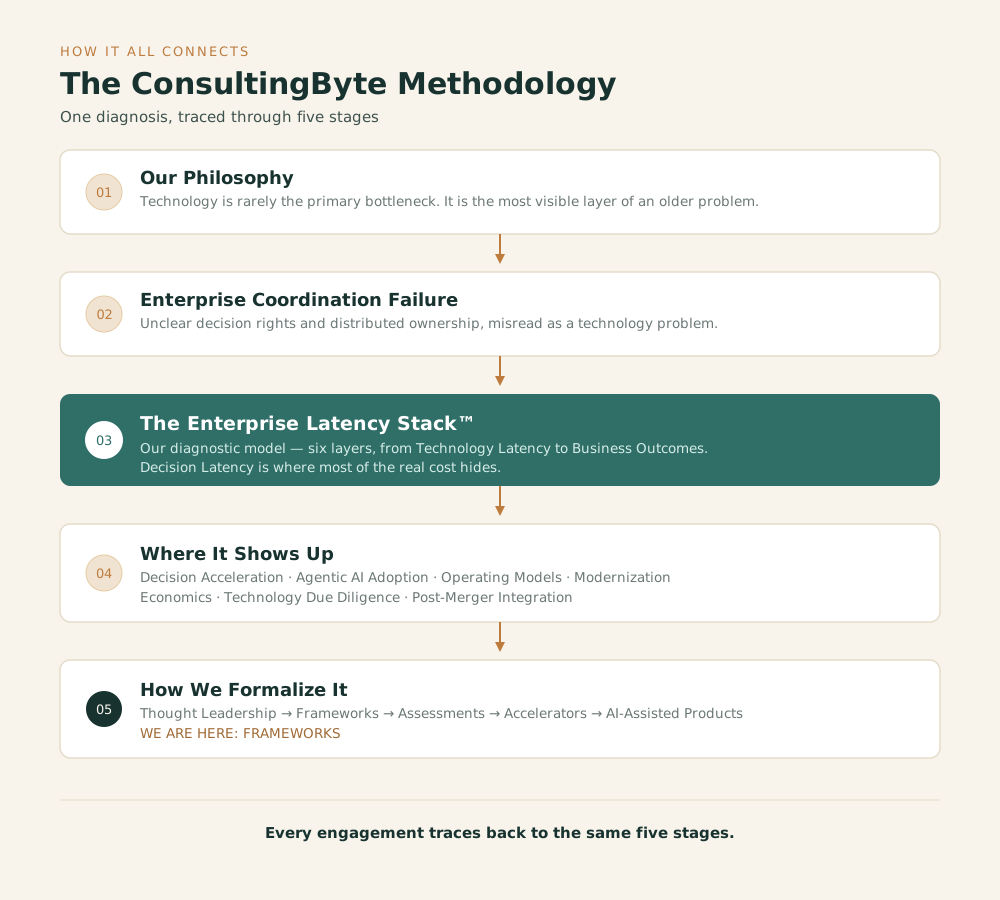
Most of what we publish, diagnose, and eventually build traces back to one line of reasoning. This page is that line, laid out in full, so any framework, article, or future assessment can point back to a single place instead of re-explaining itself from scratch.
Our Philosophy
Technology is rarely the primary bottleneck. It is the most visible layer of a much older problem, and the layer easiest to fund, so it absorbs most of the investment while the actual constraint sits somewhere less comfortable to name: unclear decision rights, competing incentives, and operating models that were never designed to keep pace with business model innovation or the speed the business now expects.
Agentic AI does not fix enterprise coordination failure. It exposes it, at a speed and scale most governance models were never built to match.
This is not an argument against technology investment. It is an argument for sequencing. Fix the coordination problem, and technology compounds. Fund technology on top of a coordination problem, and you get faster activity without faster outcomes.
Enterprise Coordination Failure
Every enterprise we have studied, across investment management, retail, banking and financial services, industrial manufacturing, and professional services, shows the same underlying pattern: delay rarely comes from a single broken system. It comes from the handoffs between people, teams, and vendors who each have a legitimate, defensible reason for moving at their own pace.
Coordination failure is not a communication problem in the team-building-exercise sense. It is a structural one. Decision rights are unclear, ownership is distributed across internal teams and external vendors without a governing strategy, and the resulting friction gets misread as a technology problem, because technology is what's visible when something is slow.
This argument is not against business teams. Businesses exist to maximize profit, and technology has traditionally served that goal rather than the reverse. Agentic AI is now disrupting that relationship. The new alignment isn't business over technology, or technology over business — it's using technology to help make the right decision at the right time.
The Enterprise Latency Stack™
This is our core diagnostic model, and the reason we do not treat "slow" as a single, undifferentiated complaint. Delay accumulates across six layers, and each layer needs a different fix:
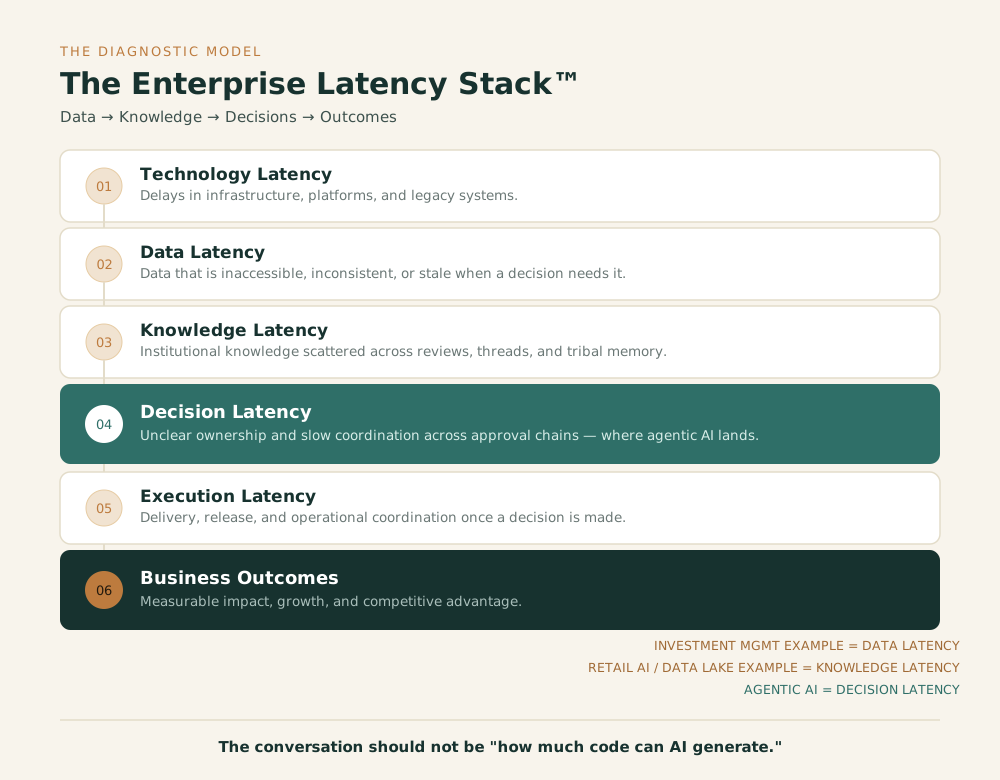
Technology Latency — delays in infrastructure, platforms, and legacy systems. Data Latency — data that is inaccessible, inconsistent, or stale when a decision needs it. Knowledge Latency — institutional knowledge scattered across reviews, threads, and tribal memory. Decision Latency — unclear ownership and slow coordination across approval chains, where agentic AI now lands hardest. Execution Latency — delivery, release, and operational coordination once a decision is finally made. Business Outcomes — the only layer that actually matters to the business, and the one every other layer either serves or obstructs.
Most organizations experience these six layers as one undifferentiated feeling of slowness. Most AI investment today targets the first layer, moving data and generating output faster, while the layer that actually determines whether a business moves faster, decisions, receives almost none of the direct investment. The Enterprise Latency Stack exists to separate those six layers so a client can see precisely which one is costing them the most, rather than funding whichever one happens to be easiest to point at.
Where It Shows Up
The same diagnosis surfaces differently depending on where in the enterprise you're standing. Six recurring contexts account for most of our engagement work:
Decision Acceleration — why enterprises move slowly, and how to systematically reduce decision latency at the layer where it actually lives. Agentic AI Adoption — practical enterprise adoption models that go beyond demo-stage hype and into measurable operating change. Enterprise Operating Models — the org design, decision rights, and governance structures that either absorb friction or generate it. Modernization Economics — business cases, ROI modeling, technical debt quantification, and platform rationalization, grounded in what a system actually costs to keep running versus what it would cost to fix. Technology Due Diligence — PE, M&A, and investment-focused technology and architecture assessments, ahead of and during a deal. Post-Merger Technology Integration — operating model, platform, and organizational integration strategy in the years after the deal closes, when the real coordination cost of a merger actually shows up.
Each of these is a different room in the same house. The wiring behind the walls is always the same diagnosis.
How We Formalize It
None of the pillars above started as a product, and none of our frameworks started as a framework. Every one of them began as a pattern we kept seeing repeat across unrelated clients and industries, and only became a named piece of IP once we'd seen it enough times to trust it generalized.
Thought Leadership comes first: naming the problem in public, in enough specific, anonymized detail that it's recognizable rather than abstract. Frameworks come next: turning a repeated pattern into something reusable and structured, like the Enterprise Latency Stack or the Decision Friction Index. Assessments follow: answering "how do we actually measure this, for this specific client" with structured questionnaires, scoring systems, and maturity models rather than a framework alone. Accelerators come after that: lightweight, software-assisted tooling that speeds up the assessment and diagnosis itself. And eventually, where the pattern is strong and repeatable enough, AI-assisted products: the diagnostic work turned into something a client can run continuously, not just once per engagement.
We are, as of today, firmly in the Frameworks stage, with the Decision Friction Index under active development and several more frameworks queued behind it. Every new piece of published thinking is meant to move one step further down this progression, not sit beside it as an isolated post.
If you recognize your organization somewhere in this page, that recognition is usually the most useful signal we can start from. The conversation that follows is rarely about which technology to adopt next. It is almost always about where, specifically, the distance between knowing and acting has become normal, and who actually owns closing it.